
1. TL;DR
Anyshift adds live production context to AI agents using Redis, then writes the enriched context back to Redis before an AI agent acts.
2. How Redis gives AI agents fast context
Redis is a fast data platform for caches, queues, sessions, search, and other runtime state. Unlike other databases such as PostgreSQL or MongoDB, it is built around in-memory access to frequently used data. As a results its super (!) low-latency access makes it very well suited to AI agents that need current context.
In addition to that and i May 2026, the Redis team released Redis Iris, which extends Redis with a context engine optimized for AI agents.
The best parts of Redis Iris are:
- Context Retriever whcih defines entities, fields, relationships, and access rules, then exposes some scoped MCP tools AI agents can call.
- Agent Memory (maybe the most useful) the memory agent need. It keeps short-term session memory and longer-term memory across sessions.
- Redis Data Integration keeps data flowing from source systems into Redis.
- Redis Search a specialzed search that can retrieve vector, structured, unstructured, and real-time data with low latency.
3. Why Redis needs production context
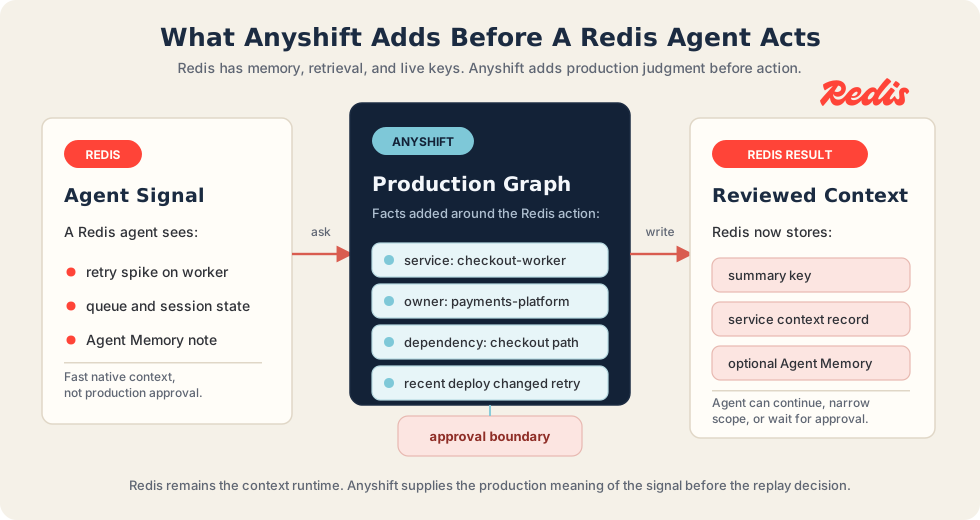
Redis is postioning itself as the real-time context layer for AI agents. Suppose an AI agent using Redis sees a failed 'payment-processing' job in a Redis-backed retry queue. The job was handled by checkout-worker, the background service that processes checkout work.
In this example, Redis records:
- the
payment_state_failedevent - the queued retry
But Redis does not explain what running the job again could affect in production.
Before retrying the job safely (and not affect the entire workload), the AI agent needs answers Redis does not hold: Did the retry behavior change recently? Which services sit upstream and downstream? Who owns the worker and must approve a production replay?
4. Anyshift in action
Anyshift provides production context for AI agents. Its production graph maps services and their production dependencies. In this example, an operator asks the Anyshift CLI (which uses the underlying Graph API) whether it is safe to replay checkout-worker in production.
The reviewed workflow identifies checkout-worker as the affected service and excludes checkout-worker-sandbox (the non-production test version of the service). Because the replay could repeat payment work in production, the service owner (aka payments-platforms, found by anyshift) must approve it before it runs. It then stores the result in Redis so an AI agent can retrieve it later.
annie do --show-yaml \
  "Is it safe to replay checkout-worker in production?"
That returns:
change: checkout-worker retry decision
redis_surface: Redis Stack / Redis Insight
owner: payments-platforms
reason: replay could repeat payment work in production
decision: owner approval required before production replay
services:
  - checkout-worker
skipped:
  - checkout-worker-sandbox
source: anyshift annie do reviewed workflow
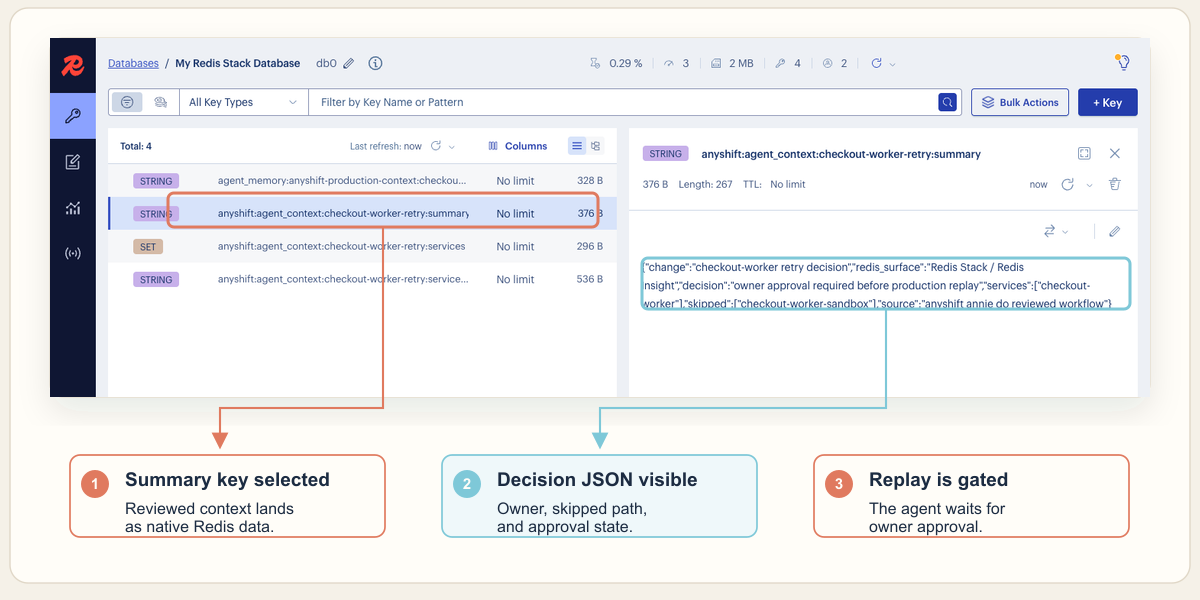
The result records the affected service, the skipped sandbox path, and the approval state shown in Redis Insight.
5. Results in Redis
Anyshift then calls the Redis API to store the reviewed result. Redis Insight shows the saved context below.
An AI agent can later retrieve this decision from Redis and wait for owner approval before attempting the job again.
If Redis Agent Memory is configured, the workflow can also store the reviewed outcome as long-term memory. A later session can recover the decision without running the review again.
6. What's next
For an agent touching queues, sessions, fraud state, rate limits, or incident remediation, in Redis the split using Anyshift stays the same:
- Redis owns memory, retrieval, and fast application context.
- Anyshift checks services, owners, dependencies, current signals, recent changes, and blast radius.
- The reviewed result returns to Redis before the agent retries, replays, or mutates production state.
If you are building a Redis-backed agent and need a production check before it acts, show us the workflow.